
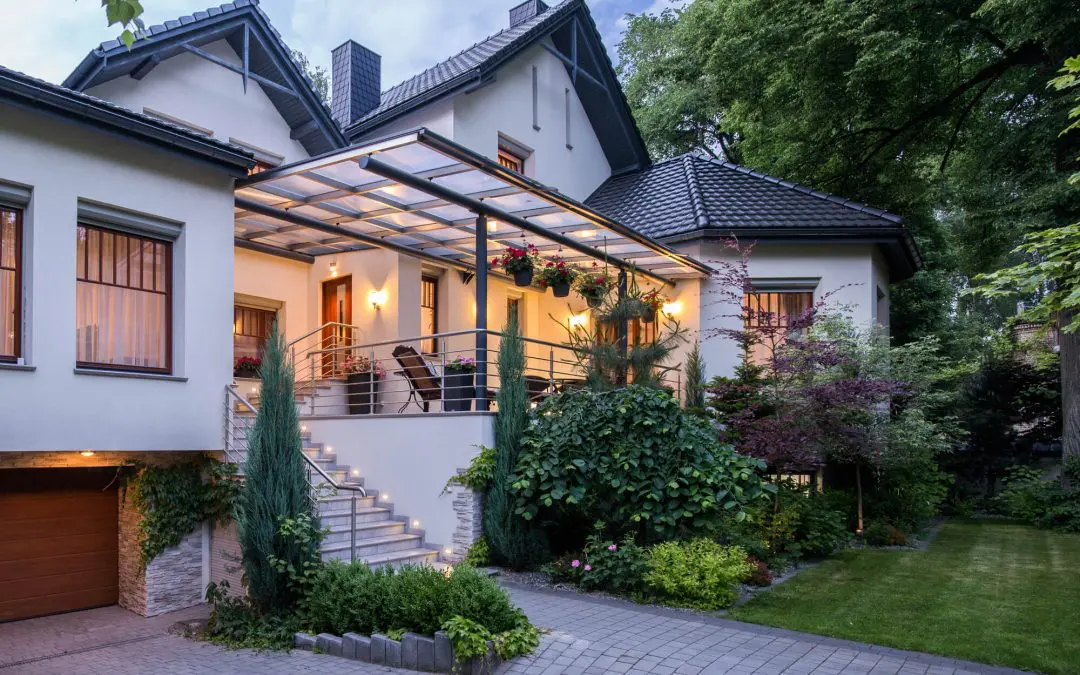
Most homes have exterior lighting that functions in a basic sense, but wasn’t designed as a system and doesn’t perform like one. Improving exterior lighting means approaching the home’s nighttime appearance and safety the way a landscape designer would: with a plan for each zone, an understanding of how color temperature affects the experience of a space, and the controls that make the system work automatically rather than requiring daily attention. The result is a property that looks intentional after dark.
How to Improve Exterior Lighting as a Complete System
The mistake most homeowners make when attempting to improve exterior lighting is starting with fixtures rather than a plan. Walking the property at night with fresh eyes, identifying where visibility is poor, where dark corners create security vulnerability, and where architectural features worth highlighting exist, is the step that makes every subsequent fixture decision purposeful. Lighting planned by zone produces a property where each area is addressed by the fixture type most appropriate for its function: ambient fixtures at the entry, directional fixtures for facades, path lights for grade changes, and security fixtures for perimeter coverage. A zone-based plan also prevents over-illumination, too much light in one area and too little in another produces a property that looks unbalanced rather than designed.
The Variable That Changes Everything
Color temperature is the lighting specification most homeowners ignore, and most designers spend significant time on, because it determines whether the property feels warm and welcoming or clinical and institutional at night. Measured in Kelvins, lower numbers produce warmer amber-toned light and higher numbers produce cooler blue-toned light. The exterior lighting color temperature range that works best for most residential applications is 2700K to 3000K, warm enough to feel inviting at the entry and on the facade, accurate enough to render landscaping colors naturally. Consistency across the system matters as much as the individual selection. A mix of 2700K path lights, 4000K floodlights, and 3500K entry fixtures produces a disjointed nighttime appearance where each zone reads differently rather than as part of a cohesive system.
How Exterior Lighting Works for the Home
Smart exterior lighting controls, such as timers, dimmers, motion sensors, and app-based systems, are what make a system functional. A well-controlled exterior lighting system comes on at dusk, adjusts brightness throughout the evening based on activity patterns, triggers motion-activated security fixtures when movement is detected, and turns off at a set time rather than running unnecessarily through the night. These controls reduce energy consumption relative to fixtures that run continuously, extend bulb life, and ensure the system performs consistently without requiring daily manual operation. The security benefit of exterior lighting is well-documented; consistently illuminated properties are significantly less attractive targets for opportunistic crime than dark ones, because lighting eliminates the concealment that most opportunistic incidents rely on. The fixtures that contribute most to security are those that eliminate dark zones rather than those that are simply bright. A motion-activated fixture that illuminates a previously dark side yard when movement is detected is more effective security exterior lighting than a brighter fixture at the entry that leaves the perimeter unaddressed.
Frequently Asked Questions (FAQs)
What is the most important zone to improve exterior lighting in first?
The front entry is the highest-priority zone; it’s where guests arrive, where packages are delivered, and where nighttime curb appeal is most evaluated. An entry fixture that is appropriately scaled and provides enough light to see the door and approach clearly addresses the zone that most directly affects safety and first impression. Path lighting along the driveway approach and motion-activated security coverage at the garage and perimeter follow as the next priorities.
How does color temperature affect appearance?
Color temperature determines the warmth or coolness of the light and significantly affects how the property feels at night. Exterior lighting in the 2700K to 3000K range produces warm, amber-toned light that reads as welcoming and residential. Fixtures above 4000K produce a cool, blue-toned light that reads as commercial in a residential context. Mixing color temperatures across the system produces a disjointed appearance; selecting all fixtures within a consistent range produces a cohesive result.
Can exterior lighting be improved without hiring an electrician?
Many improvements don’t require an electrician: low-voltage path lighting connects to a transformer that plugs into a standard exterior outlet, solar fixtures require no wiring, and replacing an existing fixture in the same location uses the existing electrical box. Improvements requiring new electrical runs, such as adding a fixture where no wiring exists or installing a hard-wired security fixture at a new location, do require a licensed electrician.
How does lighting affect home resale value?
Exterior lighting contributes to curb appeal, which consistently influences buyer first impressions and listing performance. A property with a designed lighting system presents a more polished nighttime appearance than one with basic, unplanned lighting. Real estate professionals consistently cite curb appeal as a significant factor in how quickly a home sells and at what price relative to comparable properties.
What is the best way to light a driveway or walkway?
Path lights spaced eight to ten feet apart provide enough illumination to see the surface and edges clearly without over-illuminating the approach. Alternating path lights on opposite sides of the path rather than placing them directly across from each other produces a more natural appearance. Low-voltage LED path lights connected to a timer-controlled transformer are the most practical lighting solution.
AWP Home Inspections provides buyer’s home inspections in West Central and Central Indiana. Contact us to request our services.